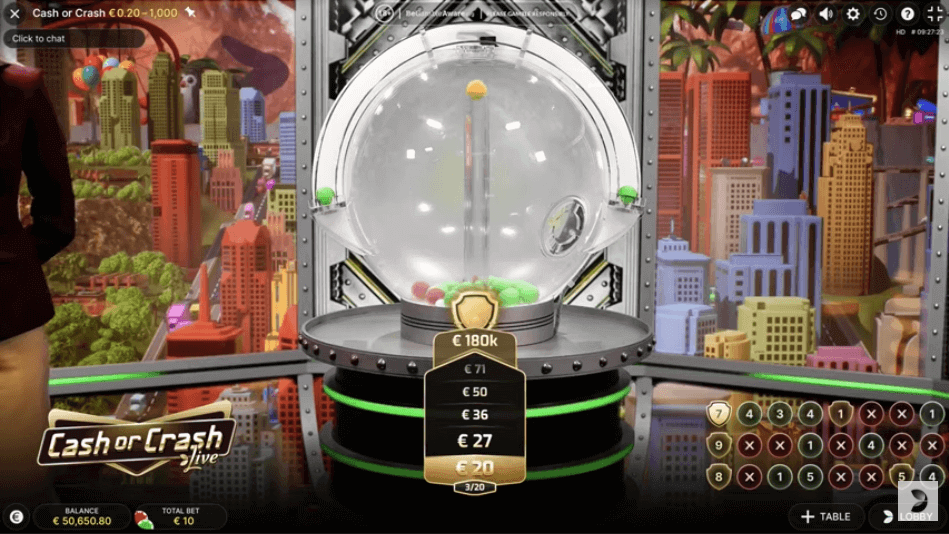
Cash or Crash Live carves out its own territory in the live game show world https://cashorcrashcasino.com/. Its charm lies in a powerful blend of studio spectacle and game design that turns every round into a personal test of nerve. This isn’t a passive spin of a roulette wheel. In this game, you are in control, actively deciding that determine your winnings. The premise captivates you with a climbing multiplier, then urges you to cash out before a hidden “crash” clears the board. To fully benefit from the game, you need to look past the lights and see how it actually works. Let’s break down the stages, the presenter’s part, the mathematics of risk, and how players can practically navigate the thrills.
The Main Goal and Core Mechanics
The aim of Cash or Crash Live is simple on the outside. You must choose when to exit a rising multiplier before a concealed “crash point” ends the turn and removes your winnings for that stage. Each game begins with players putting bets. A rocket then begins its journey, and a multiplier starts ticking up from 1x. The journey has multiple phases. Pre-launch, a random crash multiplier is determined for each stage, secret from nobody. As the value rises, players individually chooses to hit “Cash Out,” locking in that multiplier on their wager, or to remain. If the rocket triggers the hidden crash point ahead of a player withdraws, they lose their bet for that stage. The loop of risk and reward happens over multiple rounds. Players who survive grow their winnings incrementally.
Analyzing the Game Phases
View the game as a collection of different segments, each a brand new gamble. Avoiding a crash doesn’t knock you out. You advance to the subsequent stage with your built-up winnings secure, then start the risk process anew on the next leg of the rocket’s path. This setup is paramount. It generates a narrative, with tension that builds as you advance. The announcer amplifies the drama, announcing how many players are still aboard the rocket as the multiplier reaches scary heights. Initial phases often involve conservative plays. Advanced rounds, with their high-stakes multipliers, entice you to bet the gains you’ve already secured. This structure is the essence of the game’s excitement. It creates a series of separate, high-pressure decisions instead of a single one.
From Low to High Risk: The Risk Escalation
Observe the colorful route the rocket travels. It’s a key part of the game’s language. The first part is often a “Green Zone,” a lower-risk phase where a crash is still possible. Afterward, the rocket could move into an “Amber Zone,” a clear signal that risk is rising. The last segment is the “Red Zone.” At this point, multipliers appear their highest, but the likelihood of a crash is numerically at its highest. These colors are not merely ornamentation. They give you a quick visual for the degree of risk at each instant. They make an intangible probability become tangible. Knowing the game is intentionally alerting you about increasing uncertainty is a essential piece of strategic information.
Methodological Structures and User Behavior
No strategy can beat the fundamental randomness. But you can apply disciplined approaches to manage your bankroll and your emotions. The main conflict is a exchange. Do you secure assured gains, or shoot for massive gains? Users often employ methods like the “Fixed Cash-Out.” In this case, you determine ahead of time to cash out at a specific multiplier, say 2x, in every stage. This aims for steady, small wins. The contrary is the “Let It Ride” method, where you risk several rounds for a shot at a huge reward, acknowledging that failures will take place. A more measured approach is the “Percentage Bankroll” system, where you modify your bet size based on your present profits. The key aspect, though, is in your psychology. Can you overcome the “greed factor” when the multiplier rises? Can you prevent annoyance after an early crash? Your greatest asset is setting firm guidelines for yourself before the game even starts.
Frequent Errors to Steer Clear Of
Be wary of a few classic mistakes. The most damaging is “chasing” a loss. This involves impulsively boosting your stake after a loss, which contradicts the game’s round-independent structure. Another misstep is trusting the “hot hand” fallacy, believing a streak of big payouts is expected to persist. Allowing the commentator’s talk or the behavior of other users distract you from your own pre-set plan is widespread. Also, avoid misinterpreting the sections. The Amber and Red Zones are not tests to overcome. They are alerts that the danger has jumped. Entering any round without a specific aim transforms the game from a session of decisions into a complete emotional journey. That journey rarely ends well.
The purpose of the live host and RNG
The presenter is more than just talk. They determine the game’s emotional pace. While they have no impact on the result, they masterfully build suspense. They announce the climbing multiplier and give live updates on what percentage of the crowd is cashing out at each level. That social cue can mess with your head. But remember, the host is separate from the game’s engine: the Random Number Generator (RNG). The crash point for each stage is set by a certified RNG the instant the stage begins. This ensures fairness and total unpredictability. The host has no clue when the crash will happen. Their job is entertainment. The RNG’s job is certifiable fairness. This combination combines transparent live action with provably random results.
Mathematical Basics and Volatility
Let’s consider the numbers that drive the game. The multiplier for each stage comes from a fixed probability model. Frequent, small multipliers such as 1.2x or 1.5x have a high chance of being selected. Extremely high multipliers are achievable, but they are exponentially less likely. This system keeps the game fair. The frequent, small crashes pay for the rare, huge potential payouts. The “Return to Player” (RTP) is a statistical percentage spanning millions of games. During one session, the variance are wild. You’re not playing against the casino in a conventional sense. You’re making choices against a secret, unpredictable number. Remember these points:
- Separate Rounds: Each stage’s crash point is its own event. A crash of 1.2x in round one gives no info about round two.
- No Predictive Patterns: The RNG eliminates any predictable patterns. Historical crashes or big wins do not influence what comes next.
- House Edge: The system incorporates a house advantage, which is shown in the publicly disclosed RTP from the provider.
Conclusion: A Harmony of Chance and Decision
Cash or Crash Live is a captivating fusion of sheer fortune and intentional choice. Its workings are built to create a story of increasing tension, powered by a transparent RNG and brought to life by a charming emcee. Determining winning as a fun and likely rewarding round hinges on various elements. It’s not so much about predicting the uncertain and rather about comprehending how the game is designed. It demands handling your money with discipline and managing the psychological impulses the game masterfully provokes. By mastering its stages, understanding its mathematical structure, and adhering to a custom approach, you can transform your experience. You transition from confused guesswork to informed involvement in a uniquely tense live game show.
